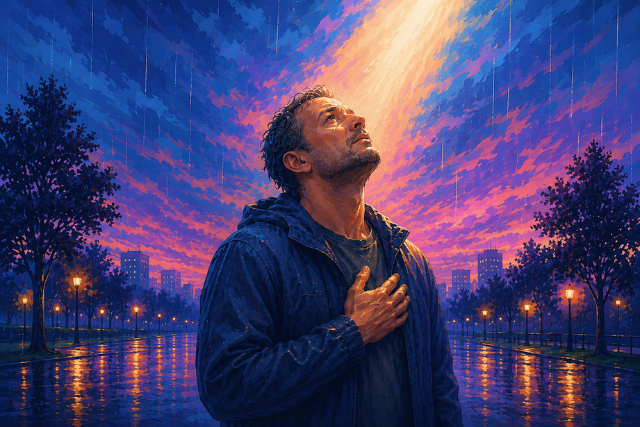

“Courage is not the absence of fear, but the triumph over it.” ~Nelson Mandela
First, I slept in a snow shelter at -20°C.
Second, I stood alone on a stage in Montreal and tried to make strangers laugh.
Third, I stuck out my thumb on the side of a highway with nothing but a backpack and hoped that a stranger would take me home, 1,200 kilometers away.
I did all of these things deliberately, on purpose, as part of a project I called my Year of Fear. The idea was simple: face one new personal fear every month for a year, write about it honestly, and see what happened on the other side.
What I didn’t plan for was the month everything fell apart.
How It Started
I was thirty-three years old, and I was afraid of almost everything.
Not in an obvious way. From the outside, I looked fine—a successful engineer, a long-term relationship, an apartment in Montreal, a life that looked like it was going somewhere.
But underneath that I was carrying a backpack full of fears I’d never once looked at directly. Fear of rejection. Fear of conflict. Fear of giving my honest opinion and having people disagree. Fear of being alone. Fear of big changes. Fear of strangers.
And most of all—the one that colored everything else—fear of not being enough.
I grew up with a lot of fear. It wasn’t natural for me to walk toward hard things. I was the kid who avoided confrontation, who changed his opinion to match the room, who kept himself small so nobody would have a reason to reject him.
At thirty-three I looked at my life and realized that fear had been making my decisions for me for as long as I could remember. It had reduced my agency, stifled my resilience, and quietly limited the size of the life I was willing to live.
So I decided to do something about it. One month at a time.
The Year of Fear
January: I snowshoed into the frigid Canadian wilderness in the middle of winter, built a snow shelter with my own hands, and slept in it overnight. I didn’t sleep much. But I woke up.
February: I did stand-up comedy at an open mic night in Montreal in front of a room full of strangers. Some of them laughed. Most of them didn’t. I survived anyway.
March: I hitchhiked 1,200 kilometers from Halifax to Montreal, trusting strangers with my safety for three days straight. Every single person who picked me up was kind.
April: I spent a full weekend at a silent meditation retreat—no talking, no phone, no distraction. Just me and my own thoughts for forty-eight hours. That one was harder than the snow shelter.
May: I went bungee jumping. I stood on the edge of that canyon for what felt like a very long time before I jumped. But I jumped.
By May I could feel something changing in me. A quiet confidence that hadn’t been there before. A growing sense that I could do hard things—that discomfort wasn’t something to flee from but something to walk toward.
I was building a muscle I didn’t even know I needed.
And then June arrived.
The Month Everything Fell Apart
In the space of six weeks, three things happened that I never saw coming.
1. I got fired from my high-paying corporate job.
2. My grandmother died.
3. And my girlfriend of six years and I broke up.
All of it. Six weeks.
If you had asked me a year earlier how I would handle losing my relationship, my income, and one of my favorite people on earth in the same month and a half, I would have told you honestly: not well. I would have told you I’d probably fall apart. Crawl into a hole. Wait for someone or something to come and fix it.
But that’s not what happened.
Don’t get me wrong—it was brutal. I cried on the Montreal metro carrying everything I owned to my friend’s couch. That first night away from the apartment I’d called home for years was one of the loneliest of my life.
But I moved through it with more steadiness than I ever thought I had.
And I’ve spent a long time since then trying to understand why.
What Five Months of Facing Fear Actually Built
Here’s what I’ve come to believe: the fears I faced deliberately in those first five months of the year built something in me that I couldn’t have built any other way.
They built resilience—not as a concept, but as a lived experience. Every time I walked toward something that scared me and came out the other side, I added another data point to a growing body of evidence: I can do hard things. Discomfort doesn’t kill me. Fear is information, not a stop sign.
So when the unexpected fears arrived—the ones I never chose, the ones that just showed up and demanded to be dealt with—I had a muscle for them. Not a perfect one. Not one that made any of it painless. But enough of one to keep moving.
The breakup was the hardest of the three losses, as breakups often are. When you’ve built a life with someone for six years, when you’ve woven your routines and your future and your sense of home around another person, losing that relationship isn’t just losing a person. It’s losing a version of yourself.
And that, I think, is what makes breakups so uniquely terrifying.
It’s not just the loneliness. It’s the identity question underneath the loneliness: who am I now?
The Fear Underneath the Fear
One of the reasons my relationship ended was something I’d known for a long time but had been too afraid to confront directly: I wanted children, and she didn’t.
I had pushed that truth aside for years. Not because I didn’t know it was there but because I was afraid. Afraid of losing her. Afraid of being alone. Afraid of starting over at thirty-three with no guarantee that the life I wanted was still available to me.
People-pleasing is just fear wearing a friendlier mask. And I had been people-pleasing in that relationship—and in most of my relationships before it—for a very long time.
When the breakup happened, I made a decision. I was done letting fear make my decisions.
From that point on I owned exactly who I was. I wanted children, and I said so early, clearly, and without apology. I stopped softening my edges to be more acceptable. I stopped changing my story to fit what someone else wanted to hear.
And when I approached someone new and got rejected—which happened many times—I had learned to reframe it as useful information rather than evidence that I wasn’t enough. If someone wasn’t interested in the real me, they weren’t the right person. Simple. Clean. Nothing to take personally.
Rejection stopped being something to fear and started being something to learn from.
What Letting Go Actually Looks Like
In the years since that breakup, I’ve thought a lot about what it actually means to let go.
I’ve realized that letting go isn’t a single moment. It’s an ongoing practice. I’ve had to let go of high expectations of others. Let go of shame around professional failures. Let go of the need for closure from people who were never going to give it to me. Let go of the idea that I could control things that were never mine to control.
It never fully ends. The letting go is the work.
But the common thread through all of it has been this: almost everything that causes us pain is something we cannot control. A relationship ending. A job disappearing. A person we love dying. The only thing any of us can ever truly control is how we respond to what happens to us.
Waiting for closure—waiting for your ex to say the right thing so you can finally move forward—is handing that control to someone who has already left. Real closure isn’t something another person gives you. It’s something you decide to give yourself.
I know that’s not easy to hear when you’re in the middle of it. I know because I was in the middle of it too. And it still took me time, even after I knew it intellectually, to actually feel it in my body.
But the moment I stopped waiting for permission to move forward was the moment things actually started to shift.
What I Know Now
I am now married to an incredible woman who loves me for exactly who I am. I have two kids I always wanted. A life I am genuinely grateful for every single day.
None of that would have happened if I had let fear continue to run the show. None of it would have happened if I had stayed in a relationship that didn’t honor what I actually wanted because I was too afraid of being alone. None of it would have happened if I kept waiting for the world to arrange itself in a way that finally felt safe enough to be myself.
The breakup I never saw coming was one of the most important things that ever happened to me. Not because it was easy. But because it forced me to stop running from fear and start learning from it.
Here’s what I want you to know if you’re reading this in the middle of your own heartbreak:
You are not broken. You are not behind. You are not too much or not enough.
You are someone who loved another person with everything you had. And you are someone who is going to figure out what comes next—not because it’s easy, but because you’re more resilient than you know.
The fear you’re feeling right now? It’s not a sign that something is wrong with you.
It’s a sign that you’re paying attention.
And that’s exactly where the work begins.

About Eric Ibey
Eric is a professional engineer and breakup recovery coach based in Canada. A decade ago he wrote honestly about his toughest breakup and was overwhelmed by the response from people who felt exactly the same way. That experience led him to create The Breakup Challenge — a free 5-day email program to help people start letting go after heartbreak. You can sign up at breakupchallenge.ca.
