There are days when the body is tired but the mind refuses to follow. We finish work, close the laptop, put away the phone—and yet the conversations continue in our heads. We replay something we said that morning, anticipate tomorrow, remember an email we forgot to send, and move from one thought to the next even after the world around us has become quiet.
Simply telling ourselves to relax may not help. Perhaps that is because relaxation is difficult to achieve when we turn it into another task. There is, however, another possibility: instead of asking the mind to become quiet, we can give it somewhere else to place its attention. A branch moving above us, cool air against the face, rough bark beneath our fingertips, or the sound of a bird somewhere beyond our sight.
Perhaps forest bathing’s greatest gift is not that the forest makes our thoughts disappear, but that for a while they no longer need to occupy the entire landscape of our attention.
This gentle movement of attention—from the thoughts within us toward the living world around us—is at the heart of shinrin-yoku, the Japanese practice widely known as forest bathing. Perhaps its greatest gift is not that the forest makes our thoughts disappear, but that for a while they no longer need to occupy the entire landscape of our attention.
Shinrin-Yoku: The Japanese Practice of Forest Bathing
The term shinrin-yoku emerged in Japan in the early 1980s and is commonly translated as “forest bathing” or “taking in the atmosphere of the forest.” The English translation can be misleading: there is no water involved; “bathing” refers instead to immersing oneself in the atmosphere of the forest. At its heart, shinrin-yoku is the practice of entering a forest environment slowly and experiencing it consciously through the senses.
Modern life can easily pull our attention away from the present moment; the forest offers an environment rich enough to hold our attention without constantly demanding it.
This distinguishes it from hiking. When we hike, our attention often has somewhere to go: a route to follow, a distance to cover, or a destination to reach. Forest bathing deliberately loosens those expectations. A session may involve walking, but covering distance isn’t the goal. What matters is not how far we move through the forest, but how deeply we notice where we are.
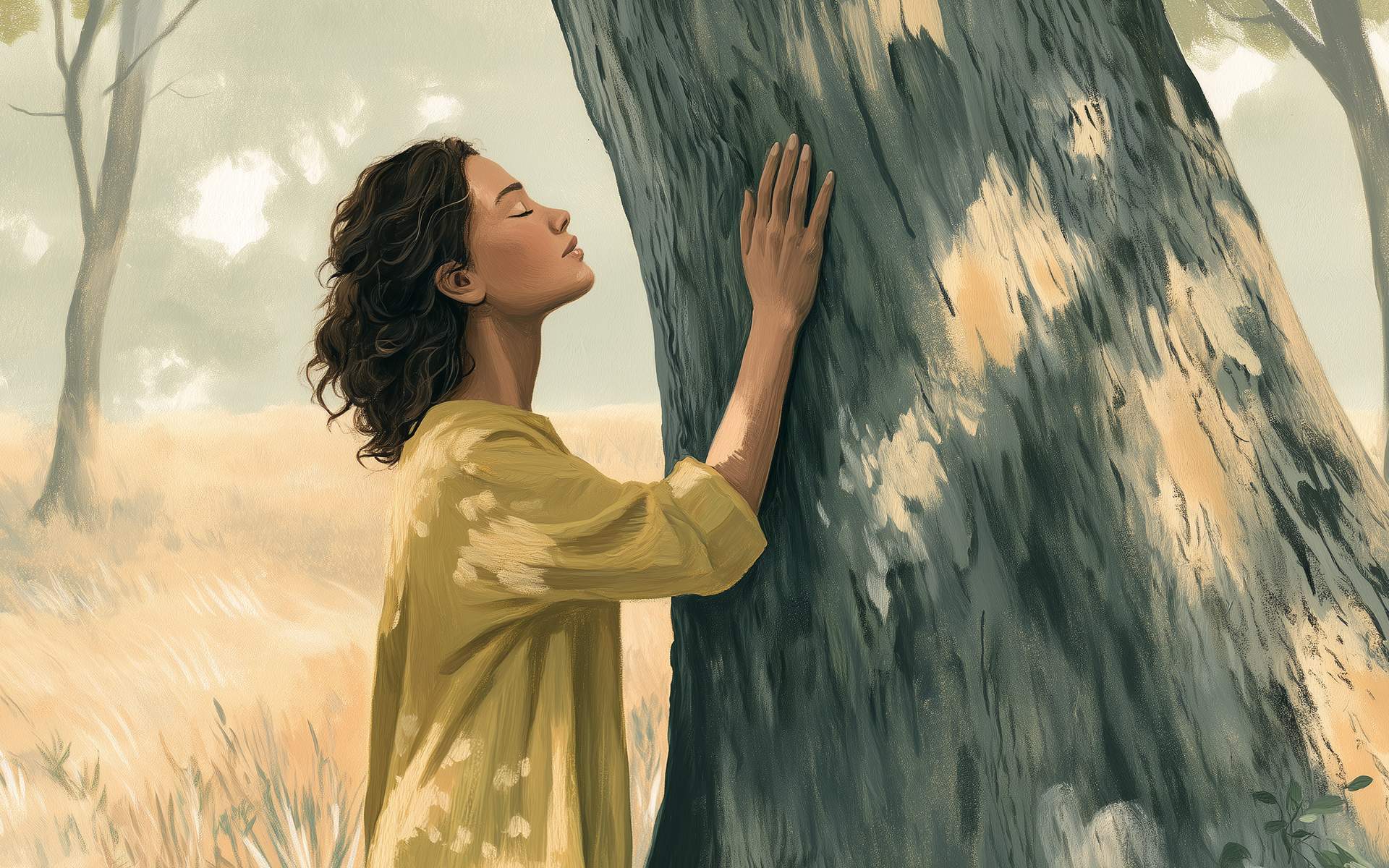
We might listen to the movement of leaves without trying to identify its source, watch sunlight shifting through the canopy, notice the scent of damp soil after rain, or rest a hand against the trunk of a tree and explore a texture we have passed hundreds of times without touching. These are simple acts, but simplicity is part of their power. Modern life can easily pull our attention away from the present moment; the forest offers an environment rich enough to hold our attention without constantly demanding it.
When Our Attention Is Always Somewhere Else
Consider how many times your attention changes direction during an ordinary hour. A notification appears, a message arrives, another browser tab opens, a headline catches your eye, and you remember something that needs to be done later. This fragmented way of paying attention can begin to feel normal, and we may carry it with us even when the external demands stop.
A tree does not need an immediate response. Birdsong does not require us to formulate an opinion. Clouds moving above the canopy are not asking to be liked, answered, or shared.
Shinrin-yoku creates a deliberate contrast. The forest is full of information, but it is information of a different kind. A tree does not need an immediate response. Birdsong does not require us to formulate an opinion. Clouds moving above the canopy are not asking to be liked, answered, or shared. We can notice them without having to do anything about them, and for a busy mind, that distinction can offer a welcome pause.
What Does the Research Tell Us About Mental Health?
The relationship between Forest bathing and psychological well-being has been studied for its potential mental health benefits. A 2023 systematic review and meta-analysis by Siah and colleagues, published in the International Journal of Mental Health Nursing examined 36 articles involving more than 3,000 combined participants and found that forest bathing interventions were associated with significant reductions in symptoms of anxiety and depression.
Other systematic reviews have also reported short-term changes across measures such as anxiety, depression, stress, and anger. At the same time, the evidence requires careful interpretation. Studies vary substantially in design, participant groups, duration, and the activities included under the terms forest bathing and forest therapy, while some studies rely on relatively small samples.
Forest bathing offers a setting and a practice where exploring attention, sensory awareness, and moments of psychological quiet can become easier to access.
Forest bathing should therefore not be presented as a treatment for anxiety or depression, nor as a substitute for appropriate mental health care. Its value may lie somewhere more subtle: it offers a setting and a practice where exploring attention, sensory awareness, and moments of psychological quiet can become easier to access.
The Forest Gives Attention Somewhere to Rest
Trying to force ourselves to “stop thinking” can quickly become frustrating. The mind thinks; that is what it does. Forest bathing takes a gentler approach. Instead of demanding an empty mind, it invites us to become interested in something beyond our thoughts.
Listen carefully to a forest and another layer of sound may be waiting beneath the first one. At first, perhaps you hear birds. Listen longer and individual calls begin to separate. Beneath them may be leaves moving in the wind, branches rubbing together, or something moving through dry leaf litter. Your thoughts may still be present throughout all of this, but they are no longer alone.
The forest gives us somewhere to return to, again and again.
The aim is not to suppress thought, but to redirect attention. We do not have to fight every worry that appears. We can notice it and gently return our awareness to what is happening around us. The forest gives us somewhere to return to, again and again.
You Do Not Have to Feel Peaceful
You do not have to walk into the woods feeling stressed and emerge transformed into a perfectly calm person. You may still be worried, sad, distracted, or impatient. You may spend the first ten minutes thinking about dinner. None of this means that you are doing it wrong.
In forest bathing, the word invitation is often used rather than exercise. This creates space for something easily lost when mindfulness becomes another self-improvement project: kindness toward our own experience.
In forest bathing, the word invitation is often used rather than exercise. An exercise can imply success or failure; an invitation simply offers a direction in which attention might move. This creates space for something easily lost when mindfulness becomes another self-improvement project: kindness toward our own experience. We can arrive exactly as we are. The forest does not require us to be calm before entering it.
A Forest Bathing Invitation: Let the Tree Hold Your Attention
Find a quiet woodland or green space and walk slowly until a tree naturally draws your attention. Stand beside it for a moment and notice its shape before touching it. Follow the trunk upward with your eyes, observing where it divides into branches and disappears into the canopy, then notice where it meets the earth.
Place one hand gently against the bark. If moss grows there, notice its texture and color. Close your eyes if that feels comfortable and pay attention to temperature, texture and pressure. Allow your breathing to settle naturally rather than trying to control it.
Now become aware of the ground beneath your feet. Imagine the tree’s roots continuing through the soil below you. As you breathe out, allow one persistent thought to loosen its grip; you do not need to remove it or solve it. As you breathe in, you might imagine the steadiness and strength of the tree and the earth beneath you. Remain there for several minutes. Whenever your thoughts pull you elsewhere, gently return your attention to the sensation beneath your hand, the earth beneath your feet, and the rhythm of your breathing. Before you walk away, spend another moment looking at the tree before walking away. Nothing about it may have changed, yet your experience of standing beside it may have shifted.
You can spend twenty minutes among trees and have nothing tangible to show for it: no distance record, no photograph, and no completed task. Perhaps that is precisely why it matters.
From Doing to Being
So much of our life is organized around outcomes. We exercise to become fitter, study to learn something, and work to complete tasks. Even rest can become instrumental: we sleep so that we can perform better tomorrow. Forest bathing offers an experience that does not necessarily need to produce anything.
You can spend twenty minutes among trees and have nothing tangible to show for it: no distance record, no photograph and no completed task. Perhaps that is precisely why it matters. There are moments when the mind does not need another achievement; it needs permission to stop achieving.
A Second Invitation: Listen Until the Forest Becomes Larger
Find somewhere safe and comfortable to sit for 10 to 15 minutes. Put your phone away and allow your body to settle without immediately searching for anything interesting. Begin with the sounds closest to you, then gradually extend your attention farther away and listen for individual layers of sound: birds calling at different distances, branches moving overhead, wind traveling through the canopy, or something moving quietly through the undergrowth.
After several minutes, allow your attention to move from sound to movement. Rather than constantly looking around, let your eyes rest on one area and wait. Small movements that escaped your attention at first may gradually emerge: an insect crossing a trunk, a bird moving between branches, or light changing across the forest floor.
Whenever your mind returns to plans, worries, or memories, notice without judgment and bring your attention back to a sound or movement. Before leaving, notice whether the place feels different from when you arrived. The forest itself may be unchanged, but you may now be aware of far more of it.
Awe does not necessarily require standing beneath a giant redwood or looking across a vast canyon. It can emerge from paying close enough attention to something ordinary.
The Quiet Relationship Between Attention and Awe
Forest bathing can also remind us of an aspect of mental well-being: awe. Awe does not necessarily require standing beneath a giant redwood or looking across a vast canyon. It can emerge from paying close enough attention to something ordinary.
Look closely at moss growing across an old trunk and it begins to resemble a miniature forest. Watch sunlight move through leaves and a familiar woodland can change minute by minute. Consider that an oak beside you may have stood in the same place through thousands of nights, storms, winters, and springs, and your own worries can momentarily take on a different scale. This does not make those worries unimportant; it simply reminds us that they are not the whole world.
The Forest Is Not Asking You to Become Someone Else
A forest bathing guide does not need to create a particular experience for the participant. The task is to create enough time, safety, and attentiveness for people to encounter the forest for themselves.
Forest bathing can sit naturally alongside mindfulness. Both practices invite us away from automatic behavior and toward conscious experience. Both emphasize returning attention gently rather than forcing it. Yet the forest adds something of its own: it reminds us that mindfulness does not have to happen entirely inside our heads. The texture beneath our fingertips, the movement of air, the smell of wet earth, the changing light, and the sound of life around us can all become anchors for attention.
We do not always have to retreat inward to find stillness. Sometimes we can step outside.
Coming Back to Ourselves by Coming Back to the World
Perhaps this is what the practice of shinrin-yoku still has to teach us more than 40 years after the term first emerged. Forest bathing is not about escaping life. Eventually, we leave the trees. The emails remain, tomorrow still arrives, difficult conversations may still need to happen and problems may still need to be solved.
Perhaps, somewhere between the trees, we have experienced a few moments in which we did not need to improve ourselves, explain ourselves, or prepare ourselves for whatever comes next.
But we may return to them differently. For a little while, we have practiced giving our attention to something that did not demand it. We have remembered what damp bark feels like beneath our hand, listened long enough for one sound to become ten, and allowed a thought to exist without immediately following it.
And perhaps, somewhere between the trees, we have experienced a few moments in which we did not need to improve ourselves, explain ourselves, or prepare ourselves for whatever comes next. We were simply present—not perfectly and not permanently, but long enough to remember that we still can be.
If this practice has sparked your curiosity, you can learn more about Forest Bathing and shinrin-yoku at Treeming.org, where we share education and resources designed to help people slow down, reconnect with nature and explore a more attentive relationship with the forest.
